Why Jewellery Manufacturers Are Switching to DLP 3D Printing?
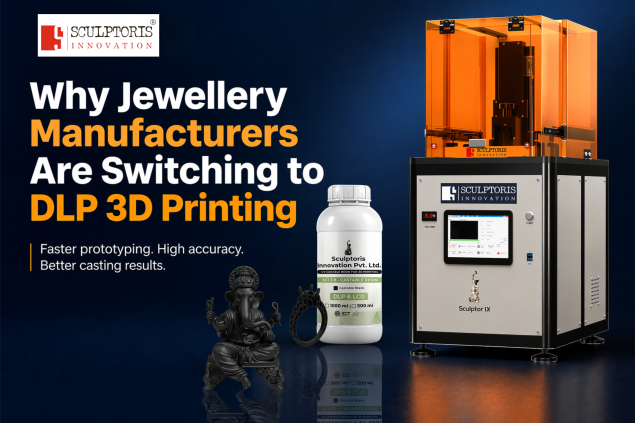
Jewellery manufacturing is changing fast. Today, customers want faster delivery, more design options, better finishing, and consistent quality. Traditional jewellery making methods are still important, but many manufacturers are now adding DLP 3D printing into their production workflow.
DLP 3D printing helps jewellers convert CAD designs into accurate resin models, which can be directly used for casting. This makes the process faster, cleaner, and more reliable for modern jewellery production.
At Sculptoris Innovation, we focus on DLP 3D printers designed especially for jewellery manufacturers who need precision, service support, and better production control.
What Is DLP 3D Printing?
DLP stands for Digital Light Processing.
In this technology, UV light is projected layer by layer onto liquid resin. The resin becomes solid wherever the light touches it. This process creates highly detailed 3D printed models.
For jewellery manufacturers, DLP is widely used to print:
- Rings
- Pendants
- Bracelets
- Earrings
- Bangles
- Jewellery masters
- Direct castable RPT models
- Custom jewellery designs
The biggest advantage is that DLP can produce very fine details, sharp edges, and smooth surfaces, which are very important in jewellery manufacturing.
Why Jewellery Manufacturers Are Moving Towards DLP 3D Printing
1. Faster Prototyping
In traditional jewellery manufacturing, creating a sample or master can take more time. If the customer asks for changes, the process becomes even longer.
With DLP 3D printing, a CAD design can be converted into a physical model quickly. This helps manufacturers show samples faster and reduce the waiting time for customers.
For jewellery businesses, faster prototyping means:
- Faster design approval
- Faster customer response
- Faster production planning
- Better control over delivery timelines
This gives jewellery manufacturers a strong competitive advantage.
2. High Accuracy and Fine Detailing
Jewellery designs often have very small details. A ring may have fine engraving, stone settings, thin prongs, small patterns, or complex artistic shapes.
DLP 3D printing is suitable for such work because it can produce high-resolution models with sharp detailing.
This is useful for:
- Micro detailing
- Thin wall jewellery
- Stone setting designs
- Intricate patterns
- Premium custom jewellery
- Lightweight jewellery designs
When the printed model is accurate, the final casting process becomes more controlled.
3. Better Design Freedom
One of the biggest reasons jewellers are switching to DLP 3D printing is design freedom.
Traditional methods can limit design possibilities. Some complex designs are difficult, time-consuming, or costly to make manually.
With 3D printing, jewellery manufacturers can easily create:
- Complex geometry
- Custom name jewellery
- Designer rings
- Lightweight structures
- Bridal jewellery patterns
- Filigree-style designs
- Unique customer-specific pieces
This allows manufacturers to offer more creative designs without increasing manual workload.
4. Improved Casting Workflow
DLP 3D printing is not only about printing. It also supports the complete casting workflow.
Using direct castable resin, jewellers can print RPT models and use them for investment casting. This reduces the need for multiple manual steps.
A good DLP workflow can help in:
- Better model consistency
- Reduced manual wax work
- Faster tree preparation
- Better repeatability
- Controlled production planning
However, casting results also depend on resin quality, post-processing, investment powder, burnout cycle, and casting parameters. So, choosing the right printer, resin, and process support is very important.
5. Suitable for Custom Jewellery Manufacturing
Custom jewellery demand is increasing. Customers now want personalised jewellery based on their own design, name, symbol, or concept.
DLP 3D printing is very useful for custom jewellery because every design can be printed digitally from CAD.
This helps jewellery businesses handle:
- One-piece custom orders
- Bridal jewellery samples
- Customer-specific ring designs
- Fast design revisions
- Limited edition jewellery pieces
For manufacturers, this means they can accept more custom work without disturbing the complete production flow.
6. Better Repeatability in Production
In jewellery manufacturing, repeatability matters. If the same design is printed again and again, the output should remain consistent.
DLP 3D printing helps maintain repeatable results when the printer is properly calibrated and the resin profile is correctly set.
This is useful for manufacturers who produce:
- Multiple pieces of the same design
- Dealer orders
- Catalogue jewellery
- Regular production batches
- Sample-to-production workflows
Repeatability helps reduce errors and improves confidence in the manufacturing process.
7. Reduced Dependency on Manual Model Making
Manual craftsmanship is still valuable in jewellery. But depending only on manual work can create delays, inconsistency, and higher labour pressure.
DLP 3D printing does not replace craftsmanship. It supports it.
It allows jewellery teams to focus more on:
- Design improvement
- Finishing
- Stone setting
- Casting quality
- Customer delivery
The digital process reduces repetitive manual model-making work and improves production efficiency.
Why DLP Is Preferred in Jewellery Manufacturing
DLP 3D printing is preferred because jewellery needs high precision and fine surface quality. Compared to some other 3D printing methods, DLP is suitable for small, detailed, and high-value parts.
Key benefits include:
- High detailing
- Smooth surface finish
- Fast print speed
- Good accuracy
- Suitable for castable resin
- Ideal for jewellery CAD workflow
- Better production repeatability
This makes DLP a practical choice for jewellery manufacturers who want quality with speed.
Where DLP 3D Printing Fits in Jewellery Production
A typical jewellery production workflow with DLP 3D printing looks like this:
- CAD design is created
- File is prepared for printing
- Model is printed using resin
- Printed model is cleaned
- Post-processing is done
- Tree preparation is completed
- Investment casting is done
- Final jewellery piece is finished
This workflow helps manufacturers move from digital design to physical production in a structured way.
Choosing the Right DLP 3D Printer for Jewellery
Before buying a DLP 3D printer, jewellery manufacturers should check these important points:
Print Accuracy
The printer should be capable of producing fine details and sharp edges.
Resin Compatibility
The printer should support direct castable and non-castable resins used in jewellery.
Service Support
For production businesses, after-sales support is very important. Machine downtime can directly affect delivery.
Build Quality
A strong and stable machine gives better long-term performance.
Software and Workflow
The printer should be easy to operate and suitable for daily production.
Casting Support
Only printing is not enough. Proper process guidance for cleaning, curing, burnout, and casting is also important.
Why Sculptoris Innovation for Jewellery 3D Printing?
Sculptoris Innovation provides DLP 3D printing solutions focused on jewellery manufacturing. Our machines are designed to support jewellers, casting houses, CAD designers, and jewellery manufacturers who need reliable printing performance.
We understand the jewellery production workflow, including printing, resin selection, model preparation, and casting challenges.
Our focus areas include:
- DLP 3D printers for jewellery
- LCD 3D printing solutions
- MJP 3D printing support
- Direct castable resin
- Non-castable resin
- Machine installation and service
- Jewellery casting process support
- Practical production guidance
For jewellery manufacturers, the right technology partner matters as much as the machine.